Abstract and System Overview

This document provides a rigorous technical analysis of Thermoelectric Coolers (TECs), commonly known as Peltier modules, integrated into a dual heatsink architecture. A TEC operates as a solid-state active heat pump that transfers heat from one side of the device to the other, against the temperature gradient, via consumption of electrical energy. To maintain steady-state operation and prevent thermal runaway, efficient heat exchangers (heatsinks) must be coupled to both the cold (heat absorption) and hot (heat rejection) junctions.
Solid-State Physics and Thermoelectric Effects
The operation of a TEC is governed by three primary interconnected thermoelectric phenomena. Click the tabs below to explore the governing physics and 1D heat diffusion principles.
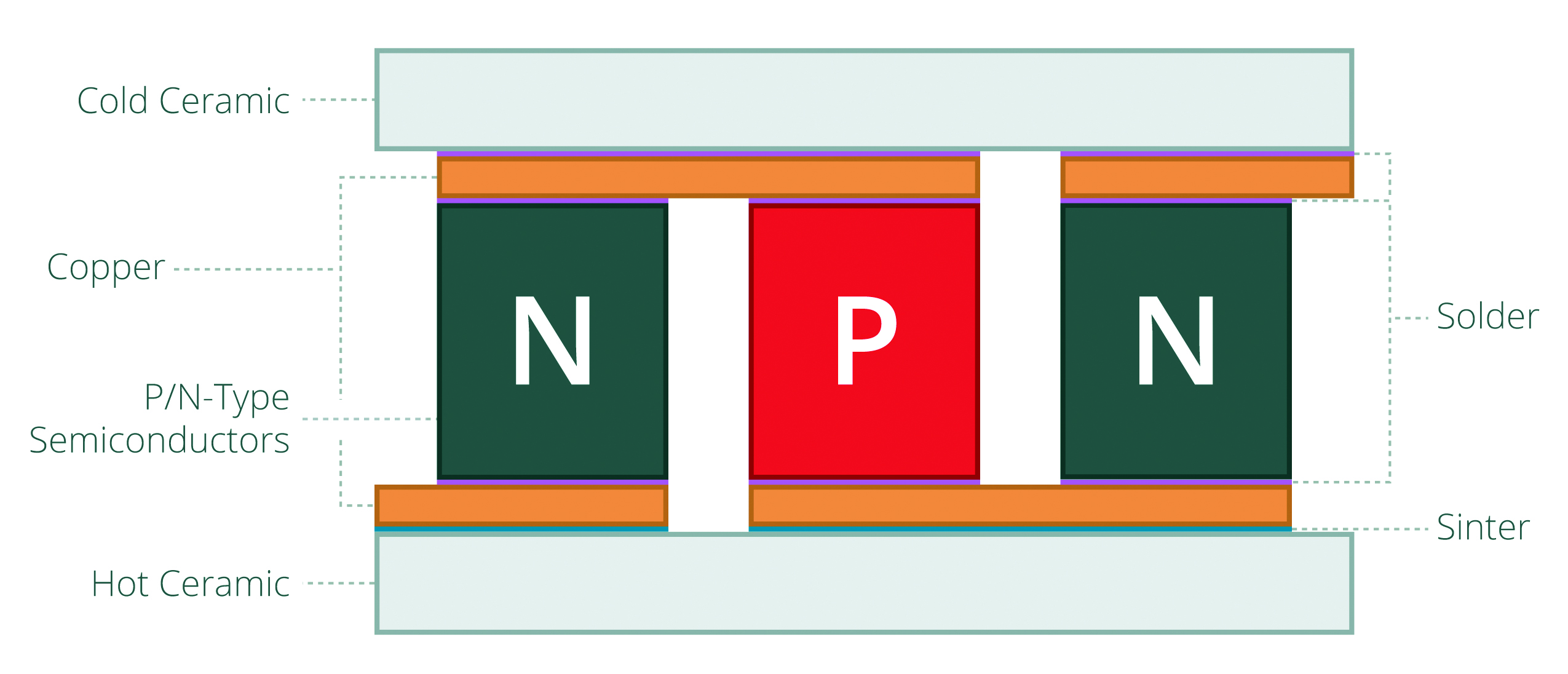
The calorimetric manifestation of the Seebeck effect in reverse. It occurs when a direct current (I) is driven through alternating heavily doped n-type and p-type semiconductor pellets (e.g., Bi2Te3), wired electrically in series but thermally in parallel.
- Π : Peltier coefficient (W/A)
- α : Seebeck coefficient (V/K)
- T : Absolute temperature (K)